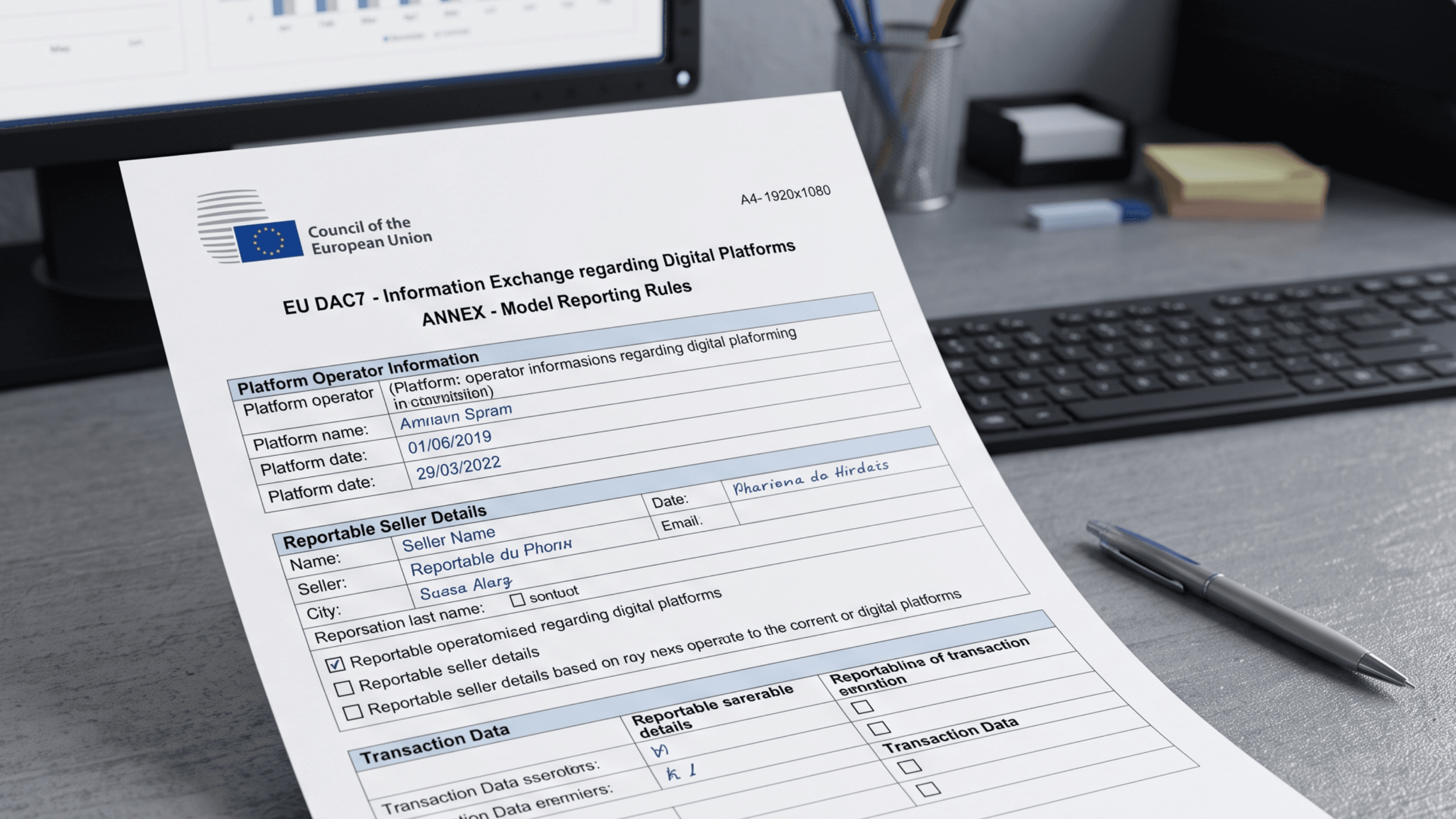
DAC7 is an EU tax rule that requires digital platform operators to collect and report information about the sellers and creators who earn income through them. Platforms must gather each payee's identity and tax ID, then report their income to a national tax authority once a year. The authority shares that data across EU member states. Agencies are affected when they operate a platform.
Digital platforms are now a major part of the EU economy, with 28.3 million people working through them in 2022 and that number expected to reach 43 million in 2025 (European Council, 2022, accessed September 2026). If you run a platform or an agency that pays creators, DAC7 turns every payout into a potential compliance question. You now have to prove who your creators are, capture their tax details and hand accurate income figures to a tax authority every year. Miss a field and you carry the risk. This guide explains what DAC7 asks for, and how a Merchant of Record can take that reporting duty off your team as an opt-in service you set up with the provider.
What Is DAC7 and Why Does It Matter for Platforms?
DAC7 is Council Directive (EU) 2021/514, an amendment to the EU Directive on Administrative Cooperation (EUR-Lex, 2021, accessed September 2026). It extends existing tax reporting rules to the digital economy, in line with the OECD Model Reporting Rules for Digital Platforms that shaped equivalent regimes outside the EU (OECD, 2020, accessed September 2026). In plain terms, it makes digital platforms responsible for telling tax authorities how much money the sellers and creators on those platforms earn.
The goal is transparency. The EU still loses substantial revenue to under-reporting, with the VAT compliance gap alone at €89.3 billion in 2022 (European Commission, 2022, accessed September 2026). Tax authorities want to see income that used to be hard to track, like earnings from marketplaces, gig work, rentals and creator monetization. DAC7 puts the collection and reporting duty on the platform operator, in addition to the individual earner.
The rule has applied across EU member states since it took effect, and each member state writes the directive into its own national law. That means the core obligations are shared but some details vary by country. Treat this article as general information and confirm your exact duties with a tax advisor.
Who Is in Scope for DAC7?
DAC7 targets platform operators. A platform is broadly any software or website that connects sellers or service providers with users and facilitates a payment. If your platform lets creators earn and you handle or enable the money movement, you are likely in scope.
Agencies enter scope when they operate a platform rather than simply acting as an intermediary. The line depends on how your setup works, so this is a good point to get specific advice.
| Likely in scope | Often out of scope |
|---|---|
| Marketplaces connecting creators with buyers | Pure advertising services with no facilitated payment |
| Platforms paying creators for content or services | Businesses selling only their own goods |
| Rental, gig and service booking platforms | Payment processors acting purely as a rail |
| Agencies that run their own payout platform | Agencies acting only as a booking intermediary |
The classifications above are general patterns. Your obligation depends on national implementation and your specific model, so verify with an advisor.
What Data Must Platforms Collect and Report?
DAC7 asks platforms to identify each reportable seller and creator, verify the details and report their income. The collection happens continuously as people onboard, and the reporting happens in a batch once a year.
| Data category | Examples |
|---|---|
| Identity | Legal name, primary address, date of birth for individuals |
| Business details | Business registration number for entities |
| Tax identification | Tax ID number and the member state that issued it, VAT number where relevant |
| Income | Total consideration paid per reporting period, often broken down per quarter |
| Fees | Commissions, fees or taxes the platform withheld or charged |
Platforms are also expected to apply reasonable checks to confirm the data is accurate rather than simply storing whatever a creator types in. Weak onboarding data is where most of the pain shows up later.
When Is the DAC7 Reporting Deadline?
DAC7 reporting is annual. Platforms report the prior calendar year's data to a national tax authority early in the following year, and that authority exchanges the information with other member states. The exact filing date and format are set by each member state, so check the deadline that applies to where you report.
What Is the DAC7 De Minimis Exemption?
DAC7 includes a narrow exemption for the smallest goods sellers. As a general pattern, a seller of goods can fall outside reporting if they had fewer than about 30 sales and received no more than roughly €2,000 in total during the year. Both conditions usually have to be met.
That exemption is aimed at occasional goods sellers. Rules for services and creator income work differently and generally do not get the same free pass, so do not assume a low earner is automatically exempt. The precise figures and their application vary by member state, so treat these numbers as indicative and confirm them for your case.
How Can Talentir Take DAC7 Reporting Off You?
Talentir acts as Merchant of Record on the payout side. For every payout you run through Talentir, Talentir is the party that contracts with the creator, pays them and stands as the operator of record for that transaction. Talentir can also take on the DAC7 collection and reporting duty for those payouts as an opt-in service you arrange with the Talentir team. Where you opt in, you do not chase tax IDs at year end, you do not assemble a filing, and you do not carry the risk of a missing field.
That is a different arrangement from a tax tool that tidies your data and still leaves you to file. Talentir collects payee identity and tax data at onboarding, verifies it, generates self-billing invoices, keeps structured records of every payout, and, when you opt into DAC7 reporting, files what DAC7 requires. Your team approves the payout and moves on.
What stays with you is anything Talentir does not pay. If creators also earn on your platform through flows that never touch Talentir, map that part with your tax advisor.
Talentir runs global payouts across 180+ countries, 24+ currencies and 10 stablecoins, with USDC and EURC the most used, and carries the liability as Merchant of Record while handling invoicing, VAT and reconciliation automatically. Talentir is a member of a self-regulatory organization under the Swiss Anti-Money Laundering Act. For more on how this works in practice, see how Talentir simplifies creator payouts and why creator payouts eat 90 percent of your time.
This is general information and not tax advice. Consult a tax advisor to confirm which of your flows are in scope.
Make Payouts easy with Talentir
Pay anyone worldwide, in seconds. We take care of payee onboarding and offer multiple currencies and payout methods. Enjoy automatically generated invoices, 1-click bookkeeping and multiple features to make payouts profitable.
FAQ
What is DAC7?
DAC7 is an EU tax rule that requires digital platform operators to collect and report information about the sellers and creators who earn income through their platforms. It extends the EU Directive on Administrative Cooperation to the digital economy so tax authorities can see income that was previously hard to track.
Who has to report under DAC7?
The platform operator has to report. Any digital platform that connects sellers or creators with users and facilitates a payment is likely in scope. Agencies fall in scope when they operate their own platform rather than acting only as an intermediary. Where payouts run through a Merchant of Record, the Merchant of Record is the operator of record for those payments and carries the reporting for them. Confirm your status with a tax advisor.
What is the DAC7 reporting threshold?
For goods sellers there is a narrow exemption, generally fewer than about 30 sales and no more than roughly €2,000 total in a year, with both conditions usually required. Services and creator income are treated differently and often do not qualify. The exact figures vary by member state.
Does Talentir handle DAC7 reporting for me?
Talentir can, as an opt-in service you set up with the Talentir team rather than something switched on by default. When you opt in, Talentir as Merchant of Record takes on the DAC7 collection and reporting duty for the payouts you run through it. Identity and tax data is collected at onboarding, every payout is documented with a compliant self-billing invoice, and the reporting is Talentir's to file. You do not file for those payouts.
Does DAC7 apply to paying creators?
Yes, when creator income is earned through a platform that facilitates payment, that platform generally has to identify the creator and report the income. A tax tool that only organizes your data does not change who files. A Merchant of Record can: with Talentir as Merchant of Record, Talentir is the operator of record for the payouts it makes and can take on DAC7 reporting for them as an opt-in service you arrange with the Talentir team.